How Highland Capital Brokerage Reclaimed Three Years of Underwriting Capacity with Pathwork

Mattie Coacher
Turning underwriting time into a competitive advantage.
At a Glance
Customer: Highland Capital Brokerage |
Industry: Life, Disability, Long-Term Care & Annuity Distribution |
Primary Use Case: APS summarization, underwriting support, case validation |
Impact: 3 years of underwriting capacity reclaimed |
About Highland Capital Brokerage
Where underwriting expertise is critical to the business
Highland Capital Brokerage is a leading life, disability, long-term care, and annuity distribution firm serving independent producers, institutions, and partner organizations nationwide. The company supports advisors across a wide range of products and case complexity. As a brokerage general agency (BGA), Highland competes on expertise, speed, and service.
That reality puts extraordinary pressure on underwriting. Every case depends on how quickly and accurately Highland’s underwriters can interpret medical records, advocate with carriers, and help advisors move forward with confidence.
The Problem: When Medical Records Stall Underwriting
For Highland’s underwriting team, medical records were the single biggest drag on productivity. That was especially true for large Attending Physician Statement (APS) files.
Before Pathwork:
Large APS files were reviewed manually or sent to offshore summarization services
Turnaround times ranged from 3–7 business days
Underwriters still had to re-check source documents for accuracy
Priority cases regularly consumed entire workdays
As Lori-Anne Walker, VP & Chief Underwriter, explained:
“If you had a 1,500-page APS, that could take days. Even when it came back summarized, you still had to double-check everything. It slowed the entire process.”
The result wasn’t just inefficiency – it limited how much time underwriters could spend on what actually drives outcomes: strategy, personalization, and advocacy.
Why Highland Chose Pathwork
Chosen for real underwriting, not generic summarization
Before committing to Pathwork, Highland evaluated vendors through an operational lens, looking for a partner that understood the realities of underwriting work. What stood out early was how differently Pathwork showed up compared to other vendors.
As Shelley Bondurant, EVP of Operations & Sales Enablement, put it:
“It shocks me how many times I find myself in front of vendors who don’t really know what they’re delivering to market.”
“With Pathwork, the conversation started with alignment – reviewing the statement of work in detail and making sure there was a shared understanding of what would be delivered and how it would support our teams.”
That rigor mattered, especially given Highland’s prior experience with APS summarization solutions.
Michelle Konsky, VP & Chief Underwriter, described how traditional summaries (whether outsourced or produced by standalone tools) often still left underwriters doing the work themselves.
“We’d get a summary back, but it could be very long, and you still had to go back into the record to check it.”
Rather than adding another long summary to re-review, Pathwork produces concise summaries tied to the source medical record, so underwriters can validate what matters without giving up judgment. That distinction made adoption easier and reduced risk, fitting naturally into existing underwriting workflows and evolving quickly as feedback surfaced.
How Pathwork Fits Into Highland’s Underwriting Workflow
From APS upload to validated summaries in minutes.
Today, Pathwork is embedded directly into Highland’s underwriting workflow.
When medical records are received:
APS files are uploaded into Pathwork
Summaries are generated in minutes – even for large files
Underwriters validate key findings by clicking directly into source pages
Chat-with-files enables targeted searches across thousands of pages
For Lori, one feature changed everything:
“Chat with files is where I find the gold. I can pull every page that mentions a specific impairment in seconds. That used to take hours.”
Beyond summarization, underwriters use Pathwork to move through complex cases more efficiently – investigating impairments, answering questions faster, and preparing for carrier conversations.
Putting Pathwork into Practice
From day one, the Highland team used Pathwork for real cases rather than hypothetical examples disconnected from daily work.
This approach allowed Highland to pressure-test Pathwork against the most complex scenarios immediately. Senior underwriters could validate accuracy, compare outputs against their own judgment, and provide fast feedback.
Senior underwriters reclaimed time almost immediately
Trust was built by validating results against source documents
Feedback loops with Pathwork were short and iterative
Once Pathwork became part of daily work, Lori noted that its impact wasn’t limited to speed or throughput. It also changed how underwriting knowledge was shared across the team.
As Lori explained:
The Results: Nearly Three Years of Underwriting Capacity Reclaimed
On average, Highland processes approximately 182,000 APS pages per year through Pathwork.

At an estimated two minutes per page for manual review, that translates to 758 workdays, or nearly three full years of underwriting capacity reclaimed.
All without adding headcount.
Highland’s underwriters reinvest that capacity into stronger case advocacy, more personalized cover letters, faster responses to advisors, and maintaining service levels during staffing gaps.
As Lori put it:
“Pathwork gives me the time to focus on strategy and custom analysis, allowing me to deliver far more value and influence on each case than I ever could the old way.”
What This Changed for Advisors
As underwriting turnaround times shortened, advisors felt the impact quickly. Faster clarity meant they were no longer waiting days for answers on complex or high-stakes cases.
Instead of telling advisors they would need to “get back to them” after extended manual review, underwriters could provide informed guidance much earlier. That shift helped advisors maintain confidence with clients and keep cases moving without unnecessary pauses.
What This Changed in Carrier Conversations
Clearer APS summaries and more focused case narratives also changed how Highland engaged with carriers. By entering conversations with a sharper understanding of the medical record, underwriters could frame cases more effectively, reduce back-and-forth questions, and advocate with greater precision.
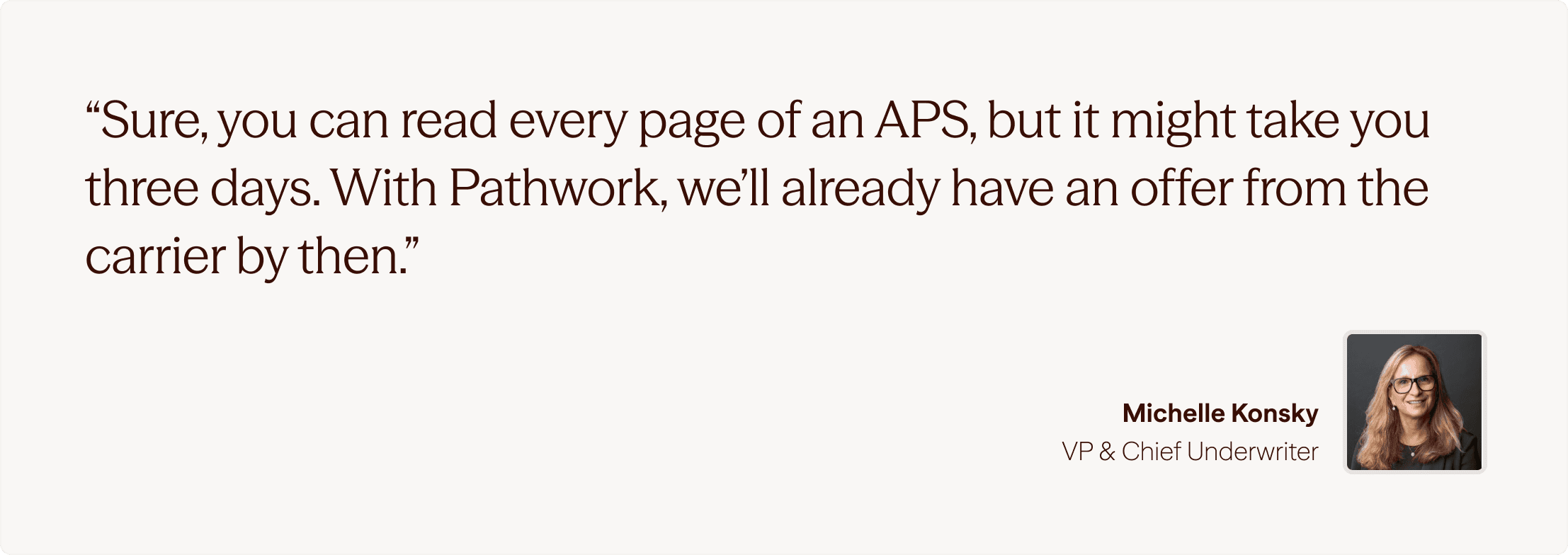
Michelle contrasted this with traditional manual review approaches:
Scaling What Works
Over time, Pathwork became more than a single workflow tool: it influenced how Highland’s underwriters approached their work and what they looked to improve next.
“Now I find myself thinking about other parts of the process and how Pathwork could help there too.”
-Lori-Anne Walker
That shift in mindset shaped how Highland approached growth more broadly.
As Adnan Raja, SVP of Digital Transformation, shared:
“For us, this was about putting the right infrastructure in place early, so we’re not rebuilding processes every time the business grows.”
See Pathwork in Action
Book a Live Demo, to see how Pathwork can compress underwriting workflows from days to minutes.